
Searching Washington County Civil Dockets
The Washington County Case Search serves as the public index for civil dockets. It covers both Circuit Court and General Sessions. Pick the specific court rather than a broad default. Set Case Type to Civil. The form takes Party Name, Case Year, and Case Number. It offers nothing for judge, attorney, status, filing-date range, setting date, document type, or party role.
Do not combine a Party Name with a full case reference in one query. The help screens suggest a complete first and last name. Case Year means the year the case was originally filed. With a formatted reference like 99GS1-2023-CV-12345, the portal tells users to enter only 12345 in Case Number. The full reference belongs in Party Name/Case Reference instead.
- Open the county-linked form and choose Circuit Court, General Sessions, or both.
- Select Civil and enter either a party name or case reference.
- Add the original four-digit Case Year when known, then complete Turnstile.
- Use Find Now and compare the court, year, case number, and parties in likely results.
- Ask the correct clerk for the docket sheet or named filing when the index is incomplete.
Washington Civil Court Routes
No single portal covers every Washington County civil docket. Circuit Court takes civil claims that include divorce, medical malpractice, workers' compensation, and other matters, plus cases that arrive by appeal or a statutory route. General Sessions holds limited civil jurisdiction. Which clerk keeps the docket depends on both the court and the category of case.
Chancery Court stands apart as a Tennessee trial court for equity, domestic-relations, and other statutory work. Probate also lives inside the Clerk & Master structure. The TNCRTInfo form has no checkbox for either one. So when a public search comes back empty and the case might belong to Chancery or Probate, ask the Clerk & Master next.
Inside a Washington County Civil Docket
Behind every case sits a chronological index. A Washington County civil docket may point to a complaint, petition, answer, motion, notice, order, minute entry, judgment, or later activity. The public portal can show only part of that record. Tennessee's TJIS civil coversheet model explains the common fields. It cannot promise each field appears in a Washington County online result.
| Court and docket number | The division and court identifier used to route the file and later requests. |
|---|---|
| Filing date | The date the case or pleading entered the court record, not necessarily a hearing date. |
| Parties and roles | Plaintiff, petitioner, defendant, respondent, or another role when the public record displays it. |
| Case type | The reported claim or family, property, probate, or other civil category. |
| Docket activity | Filed papers, settings, minute entries, rulings, judgments, and later events. |
| Disposition | Settlement, dismissal, transfer, trial result, default, withdrawal, or another reported manner. |
Washington Civil Search Fields
The narrow field set works well when used as designed. It also explains why a valid civil docket case can slip past a search. The original query fields search the database itself. The separate Filter box only works on the displayed result text. It skips the portal's phrase and typo logic.
| Field | Use | Limit |
|---|---|---|
| Party Name | Full name or exact case reference | First ten words considered; do not combine name and reference |
| Case Year | Original filing year | Not the hearing or last-activity year |
| Case Number | Final numeric segment | Full formatted reference goes in the other field |
| Court Type | Circuit or General Sessions | No Chancery or Probate choice |
| Case Type | Civil or Criminal | Broad category only |
Results stop at 2,500 rows. Quotation marks support exact phrases, and the help notes limited typo tolerance. Narrow a common name with the filing year and the correct court rather than leaning on the result Filter.
Civil Case Types on the Docket
Washington County civil dockets run through more than one office and legal track. The FY25 state table lists Circuit civil categories. Chancery and Probate keep separate functions. Classification helps aim a search. The clerk still decides the actual division for a given filing.
- Contracts, debt, specific performance, damages, torts, and real-estate claims.
- Medical malpractice, workers' compensation, and miscellaneous general civil matters.
- Divorce, parenting, child support, paternity, and other domestic-relations matters.
- Orders of protection and judicial hospitalization, which may involve access limits.
- General Sessions or juvenile appeals and matters transferred under a statutory route.
- Probate, conservatorship, guardianship, adoption, and surrender matters in separate systems.
A public line may show that an event happened. A protected attachment, financial item, medical record, address, or child-related filing can stay unavailable. The docket and the full case file are related, but they are not the same thing.
Washington Civil Docket Volume
The FY25 Tennessee AOC table counts 670 Washington County civil filings and 758 dispositions. Those are annual reported counts. They are not a live tally of pending cases or people. Damages and torts, divorce without minor children, residential parenting and child support, and contracts or debt made up the largest reported filing groups.
The pending report splits 164 Chancery records from 68 Circuit Civil records. That is a clear split. It labels them pending records and sorts them by age. No current September 2026 total can be drawn from it. The split mainly proves a searcher must check both offices.
Civil Docket Settings and Hearings
A civil filing date is not a court date. A Washington County docket may hold many items. Motion settings, conferences, trial dates, scheduling orders, and later resets all appear there. Confirm the event details with the clerk. Bring the division, room, date, time, and event type when you check. The county-linked Today’s Docket can supplement a current check. It works as a calendar-style display, not a history of civil filings.
A continuance shifts a scheduled event. It does not dismiss the claim. A default is likewise distinct from a routine reset or an uncontested result. When a setting changes, the newest court order plus clerk confirmation controls. See the broader Washington County court dates resource for how the daily display differs from the case index.
Washington Civil Record Requests
Before you call the clerk about a Washington County civil case, gather the basics. Know the court and the division. Have the filing year, the case number, your party role, and the exact document name ready. Ask for a specific paper. The complaint or petition, the answer, the judgment, an order, a minute entry, or the docket sheet all work. Requesting the whole file costs more and slows things down. Say whether you want to inspect the record. A plain copy, a certified copy, or an exemplified copy each cost different amounts. The clerk can tell you which forms of copies are available.
For fees, Washington County publishes an official 2026 Chancery fee schedule. The clerk can quote exact line items over the phone. Circuit civil pricing for plain, certified, exemplified, search, mailing, and docket-sheet copies is not published the same way. Ask for a quote. Do not borrow Register of Deeds fees; that schedule covers a different office. A specific document request is easier to route and price than a request for every paper in the file.
Civil Docket Access Rules
Tennessee Supreme Court Rule 34 gives the public the right to inspect court records. A law, rule, or court order must say otherwise to close them. A docket entry on a Washington County civil case does not promise online access to the filed document itself. Family cases often hold protected details. Think children's information, addresses, medical facts, and finances. Adoption and surrender records may stay closed to the public. Sealed exhibits and similar protected matter may as well.
Tennessee Rule 1A sets the sealing standard for civil records. A serious interest must outweigh public access. No less restrictive alternative can do the job. The clerk follows the governing order and cannot simply hand over restricted material. Ask whether a redacted public version exists and what authority controls the withheld item.
Public docket, limited file: A visible case number or event can coexist with sealed attachments and protected details. Verify access with the court that keeps the record.
Washington Civil Court Source
Tennessee's official court forms and local court pages serve two different jobs. Forms support a filing; the county index and the clerk handle docket access. The AOC General Sessions civil forms cover statewide needs. Indigency, installment requests, garnishment issues, and appeals are included. The local clerk must confirm that a form fits your Washington County case. The clerk can also explain the fee or waiver process.
That official forms page lists what the state approves for General Sessions civil filings.
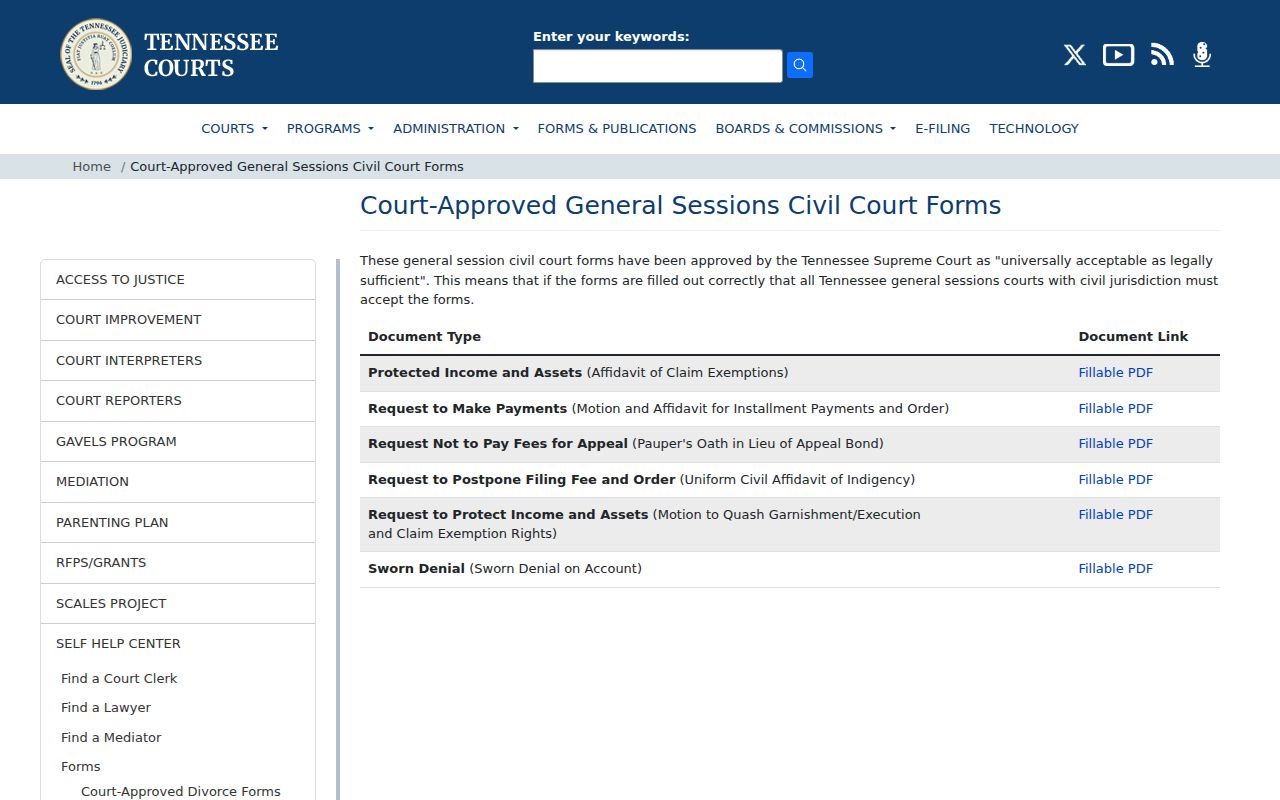
The distinction stays simple: official forms support a court filing, while the county index and the maintaining clerk provide docket access.