
Washington County Court Calendars Explained
Need a public Washington County court calendar? The county posts a link to Infax Today's Docket. It works like a daily calendar. Columns cover Case Name, Room, Start Time, and Case Number. A search box sits on top. You can sort the headers and choose which columns show. You can also flip through pages of 10, 20, 50, or 100 rows at a time. It can, however, come up empty. The display carries no court-specific refresh schedule, no past-date archive, no judge filter, and no case-type legend. An empty screen does not mean no hearings are set. It only means the public view shows none right now. Trust the date printed on your citation, notice, or order. Confirm with the clerk who maintains the case.
Washington Today’s Docket Limits
Today's Docket answers one narrow question. What does the public display list today by name, room, time, and case number? It is not a case history. When the case-type column is blank, you cannot tell what an entry is. It could be an arraignment, a motion, a plea, a trial, a conference, or a probation review. Guessing the setting type from a name alone leads people wrong. The official page tied to Washington County court dates is the live Today's Docket. That live version, not any saved screen, reflects the current schedule.
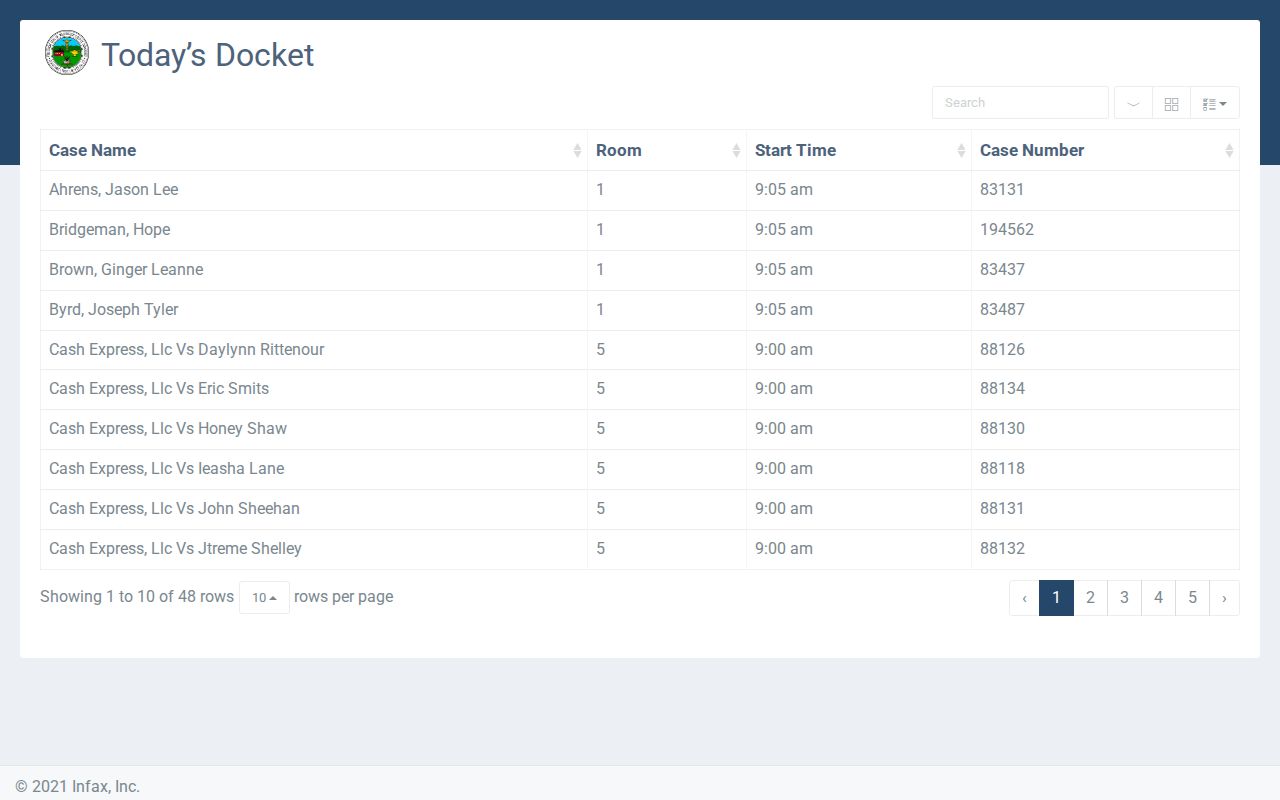
The table controls make the docket handy for a quick daily check. But a view that shows nothing is exactly why you still confirm with the clerk before relying on it.
Finding Your Court Date
Start with the newest paper connected to the case. A citation, scheduling order, bond paper, notice, or a message from your attorney will usually name the court and the date better than any broad index can. Then take that information online and compare. Keep in mind the county case search and the daily docket are separate systems, and each shows different fields.
- Read the latest citation, notice, or order for the court name, case number, date, time, and location.
- Check Today’s Docket for a current public listing by case name or case number.
- Use the county Case Search to identify a Circuit or General Sessions case, not to assume that Case Year is the next date.
- Call the maintaining clerk with the court, division, and case number. Ask whether the event is still set and what type it is.
- Check any current courtroom or courthouse posting at the court. A posted docket call may reflect a late change.
- Confirm with the attorney in the case, if represented, and follow the newest court order or direct instruction.
Tennessee offers no single public statewide trial-court calendar. The state appellate portal covers appellate dockets only. Chancery, Probate, Criminal Court, Juvenile, and municipal dates may each sit with their own clerk, since not all of those courts appear as choices in TNCRTInfo.
Washington Court Date Fields
A Washington County docket can carry several date labels, and only one may be the next hearing. In TNCRTInfo, the Case Year marks the year the case was originally filed. TJIS reporting models separate filing dates from disposition dates. Today's Docket highlights a start time but keeps no historical calendar. So label the source first. Only then treat a value as a real setting.
- Filing date
- The date a case or paper entered the court record.
- Case Year
- The original filing year used as a county portal search field.
- Setting
- A scheduled court event that may later be reset, continued, or removed.
- Disposition date
- The reported date of an outcome, not necessarily the plea, trial, or sentencing date.
- Last activity
- A later docket event that may not be a future court date.
If a search result shows a date but no setting label, do not read it as an appearance deadline. Ask the clerk what the event is and where its status stands today.
How to Read a Court Setting
A solid Washington County court setting pulls several fields together. Today's Docket shows the public four of them. Those are room, start time, case name, and case number. A full notice or the clerk's calendar may add more: the calendar date, the court, the judge, and the type of setting. Whatever is missing should get confirmed, never guessed.
| Date | The calendar day on the latest notice or current clerk schedule. |
|---|---|
| Start time | The public docket-call or listed start time, which may not be an individual hearing time. |
| Room | The room shown on Today’s Docket; confirm the building and floor with the clerk. |
| Court or judge | The division or judicial officer responsible for the setting when the official notice identifies one. |
| Setting type | Arraignment, preliminary hearing, motion, plea, trial, conference, review, or another event. |
| Case number | The identifier used to match the calendar line to the correct file. |
Washington Calendar Clerk Routes
Which clerk you call depends on which Washington County court holds your case. General Sessions can carry misdemeanor, felony preliminary, traffic, civil, and specialty settings. Criminal Court takes the felony trial-court events that arrive by bind-over, indictment, or presentment. Circuit Court runs its own civil docket. Chancery and Probate sit with the Clerk & Master. Juvenile and the city courts keep separate clerks entirely.
| Matter | Calendar source | Confirmation route |
|---|---|---|
| Circuit or General Sessions | TNCRTInfo index and Today’s Docket may help | Maintaining Circuit or Sessions clerk |
| Felony Criminal Court | No complete public file calendar was confirmed | Criminal Court clerk |
| Chancery or Probate | No county public portal was found | Clerk & Master or Probate office |
| Juvenile | No public search found | County or Johnson City Juvenile Court as jurisdiction requires |
| Municipal | City-specific citation or court channel | Johnson City, Jonesborough, or Watauga clerk |
The court name matters as much as the date. The active Justice Center, the historic courthouse, city court, and the archive are four different destinations. A county government meeting listing is never a stand-in for a case setting.
Washington Agenda Is Not Court
The Washington County Agenda Center posts county government meeting material. That is useful for tracking public meetings and the county's own timeline. But it is not a case calendar. A meeting date there tells you nothing. It will not say when a civil motion, a criminal plea, a Sessions hearing, or a municipal citation is set. County pages say "agenda." Court systems say "docket," "calendar," "setting," or "case history." Match the page to your case number and court before acting on any date. Notices and orders from the court itself always control over a general county event page.
Continuances, Resets, and Cancellations
A Washington County court date can move several ways. A continuance, a reset, an amended order, or a removal from the calendar all count. A "continued" or "reset" entry is just a scheduling action. It is not a dismissal, and it is not a final disposition. The old date may still sit in the docket history even after a new event is entered. So do not read the earlier line as the live setting. A missing Today's Docket row does not cancel your appearance either. The public display publishes no refresh policy. Call the clerk who maintains the case and ask three things. Is the matter still set? What order changed it? Was a new notice issued? If you have a lawyer, tell counsel as well. Keep the newest written order close. Confirm any moved setting by case number and division. A name alone can land you on the wrong docket.
Washington Remote Court Settings
Tennessee Supreme Court Rule 55 lets a judge use audio and video tools when the court chooses. That choice is discretionary. Nobody gets a public livestream by default. A Washington County hearing is not guaranteed to be remote. A docket entry alone will not tell you the setting is virtual. Treat the calendar line with care.
Call the clerk or the judge's office. Ask for the technology order in that case and the instructions for joining. The link may be public, limited to the parties, or withheld entirely. Identity checks or filing rules may apply. If the order requires you in person, the general remote-court rule yields to it. Show up as directed.
If You Miss a Court Setting
Missing a Washington County court date calls for fast action. Pull out the notice first. Confirm the case number and which court holds the hearing record. Then call the clerk who keeps that docket. Include any attorney on the case. Ask what the court entered after your absence. Find out how the next setting will be communicated. An old docket entry on a website may be stale. Never treat it as your reason to skip appearing again.
Missed setting: Consequences depend on the case and the court's action. A criminal matter may involve a failure-to-appear order, warrant, or bond issue.
Contact the clerk and your attorney promptly. Only the court can state what was entered and what step is now required.
Be clear about what the clerk can do. The office will walk you through docket activity and its own procedure, but it cannot give legal advice. For that, talk to a licensed Tennessee attorney. When you call, write down what you are told, and get the new order or notice in hand rather than trusting a date given only over the phone.